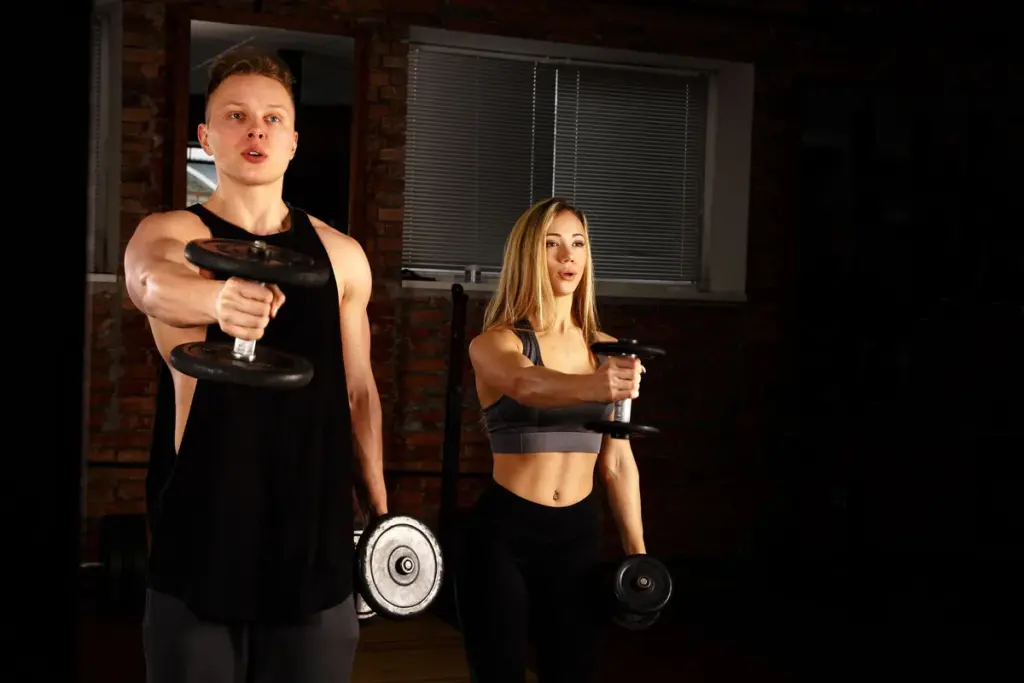
Photo: Ketut Subiyanto / Pexels
How Many Sets per Muscle per Week? What Training-Volume Research Shows
Key takeaways
- Meta-analyses show a dose-response: more weekly sets per muscle are linked to more muscle growth, but each extra set adds less. Evidence: Moderate
- In one meta-analysis, 10 or more weekly sets per muscle tended to produce more growth than fewer than 5, though the trend was not statistically significant. Evidence: Moderate
- When total volume is equal, training a muscle once, twice or three times a week gives similar muscle growth; pick the split that suits your schedule. Evidence: Strong
- For general health, guidelines ask for much less: muscle strengthening for all major muscle groups on 2 or more days a week. Evidence: Strong
“How many sets should I do?” is one of the most practical questions in strength training. Training volume, usually counted as hard sets per muscle per week, is one of the main variables researchers have studied for muscle growth (hypertrophy).
This roundup summarises what meta-analyses report about weekly volume, training frequency and effort, and how to turn that into a plan you can actually stick to at home.
Evidence at a glance
| Question | What the evidence suggests | Evidence level | Main sources |
|---|---|---|---|
| Do more weekly sets build more muscle? | Yes, in a graded dose-response, with diminishing returns. | Moderate | Meta-analyses, 15 and 67 studies [1][2] |
| Does strength respond the same way? | Strength also rises with volume, but levels off sooner. | Moderate | Meta-regression [2] |
| How often should a muscle be trained? | With equal volume, frequency does not meaningfully change growth. | Strong | Meta-analysis, 25 studies [3] |
| Do sets have to go to failure? | No evidence that failure training beats stopping short for growth. | Moderate | Meta-analysis, 15 studies [4] |
| How much for general health? | All major muscle groups on 2 or more days a week. | Strong | HHS guidelines [6] |

Weekly volume bands compared
| Weekly sets per muscle | What research suggests | Who it may suit |
|---|---|---|
| Fewer than 5 | Still produces growth, but less than higher volumes in Schoenfeld 2017 [1]. | Beginners, busy weeks, maintenance. |
| 5–9 | Intermediate category in the same analysis [1]. | Most people training 2–3 days a week. |
| 10 or more | Tended to give the most growth, with diminishing returns as volume climbs [1][2]. | Experienced lifters who recover well and have time. |
How it works
A “set” in this research usually means a set taken reasonably close to failure. Volume is counted per muscle, so one set of bench press counts for the chest. Newer research also counts sets that train a muscle indirectly: the 2026 meta-regression by Pelland and colleagues found the best predictions when indirect sets (for example, triceps during bench press) counted as half a set [2].
Frequency is how many days per week the muscle is trained. Volume can be spread over one long session or several shorter ones.
What the research says
Volume and muscle growth. Schoenfeld and colleagues (2017) pooled 15 studies (34 treatment groups) and found a graded dose-response: each additional weekly set was associated with an extra 0.37% gain in muscle size on average [1]. When weekly sets were grouped into fewer than 5, 5–9, and 10 or more per muscle, there was a trend favouring higher volumes that did not reach statistical significance [1].
The larger 2026 meta-regression (67 studies, 2,058 participants) confirmed that muscle size and strength increase as volume increases, but with diminishing returns, which are considerably more pronounced for strength [2].
Frequency. A 2019 meta-analysis of 25 studies concluded there is strong evidence that, when volume is equated, training frequency does not significantly or meaningfully affect muscle growth, so people can choose a weekly frequency based on preference [3]. In the 2026 analysis, frequency mattered for strength gains but its effect on muscle size was compatible with being negligible [2].
Effort. A 2023 meta-analysis of 15 studies found no evidence that training to momentary muscular failure is better for hypertrophy than non-failure training [4].
Guidelines. ACSM recommends higher-volume, multiple-set programmes to maximise hypertrophy, with loads emphasising the 6–12 repetition range and 1–2 minutes of rest [5]. For general health, the U.S. guidelines set a much lower bar: muscle-strengthening activity of moderate or greater intensity for all major muscle groups on 2 or more days a week [6].
Limits of the research
- Short and small studies: most last weeks to a few months, often with small groups.
- Who was studied: in the 2026 analysis, participants averaged about 25 years old and 79% were male [2]. Results may differ in older adults and women.
- Counting sets differently changes the answer: whether indirect sets count affects the estimated optimum [2].
- Averages hide individual responses: some people respond more or less to the same volume.
- No exact optimum: the research shows a trend with diminishing returns, not a single “best” number.
Who should be careful
- Beginners: start at the low end; you will grow on fewer sets, and soreness is high early on.
- People with joint pain, a past injury or a medical condition: ask a doctor or physiotherapist before raising volume.
- Older adults: recovery may take longer; add balance work as guidelines advise [6].
- If sleep, stress or appetite suffer, volume may be too high for now.
How to apply this at home
- Start with a sensible baseline: train each major muscle group at least twice a week [6], with a few hard sets per muscle per session.
- Count your weekly sets per muscle. If you are progressing and recovering well, add one or two sets per week to lagging muscles [1][2].
- Pick a split that fits your week. Full-body three times a week or upper/lower four times a week both work when volume is similar [3]. The free Workout Planner builds a plan for your days and equipment.
- Stop most sets one or two reps short of failure [4], especially without a spotter.
- Choose loads in the 6–12 rep zone for most sets [5]. The 1RM Calculator converts your best set into training weights.
- Support growth with protein: the Protein Calculator estimates a daily range.
Track sets per muscle and see your weekly volume with a free Fibody membership.
Frequently asked questions
Is 10 sets per muscle per week the magic number?
No. In Schoenfeld 2017, 10 or more weekly sets tended to produce more growth than fewer than 5, but the trend was not statistically significant, and later work shows diminishing returns rather than a single target [1][2].
Is it better to train each muscle twice a week?
For muscle growth, when total volume is the same, frequency did not meaningfully matter [3]. Training more often can make it easier to fit in more sets, and may help strength [2].
Do warm-up sets count?
Studies generally count working sets, not light warm-ups.
Can I build muscle with only dumbbells at home?
The studies measure volume and effort, not a specific type of equipment. If dumbbells let you reach enough challenging sets, they can do the job.
Related on Fibody
- Tool: Workout Planner, 1RM Calculator and Protein Calculator.
- Method: Bodybuilding and Strength training.
- Guide: How to Choose Adjustable Dumbbells for a Small Apartment.
- Shop: Home strength equipment.
More in Training Methods
References
- Schoenfeld BJ, Ogborn D, Krieger JW. Dose-response relationship between weekly resistance training volume and increases in muscle mass: a systematic review and meta-analysis. J Sports Sci. 2017;35(11):1073-82. PMID 27433992. pubmed.ncbi.nlm.nih.gov/27433992/ (accessed 31 October 2026)
- Pelland JC, Remmert JF, Robinson ZP, Hinson SR, Zourdos MC. The resistance training dose response: meta-regressions exploring the effects of weekly volume and frequency on muscle hypertrophy and strength gains. Sports Med. 2026;56(2):481-505. PMID 41343037. pubmed.ncbi.nlm.nih.gov/41343037/ (accessed 31 October 2026)
- Schoenfeld BJ, Grgic J, Krieger J. How many times per week should a muscle be trained to maximize muscle hypertrophy? A systematic review and meta-analysis of studies examining the effects of resistance training frequency. J Sports Sci. 2019;37(11):1286-95. PMID 30558493. pubmed.ncbi.nlm.nih.gov/30558493/ (accessed 31 October 2026)
- Refalo MC, Helms ER, Trexler ET, Hamilton DL, Fyfe JJ. Influence of resistance training proximity-to-failure on skeletal muscle hypertrophy: a systematic review with meta-analysis. Sports Med. 2023;53(3):649-65. PMID 36334240. pubmed.ncbi.nlm.nih.gov/36334240/ (accessed 31 October 2026)
- American College of Sports Medicine. Position stand: Progression models in resistance training for healthy adults. Med Sci Sports Exerc. 2009;41(3):687-708. PMID 19204579. pubmed.ncbi.nlm.nih.gov/19204579/ (accessed 31 October 2026)
- U.S. Department of Health and Human Services. Physical Activity Guidelines for Americans, 2nd edition. 2018. odphp.health.gov/our-work/nutrition-physical-activity/physical-activity-guidelines/current-guidelines (accessed 31 October 2026)
Medical disclaimer. This article summarises published research and public-health guidance for general information. It is not medical advice and does not replace a doctor, physiotherapist or other qualified professional. Stop exercising and seek medical help if you have chest pain, fainting, severe shortness of breath or sharp pain. See our Medical Disclaimer.
Last reviewed on 31 October 2026 · Next scheduled review: 31 October 2027 · Changes: First version.