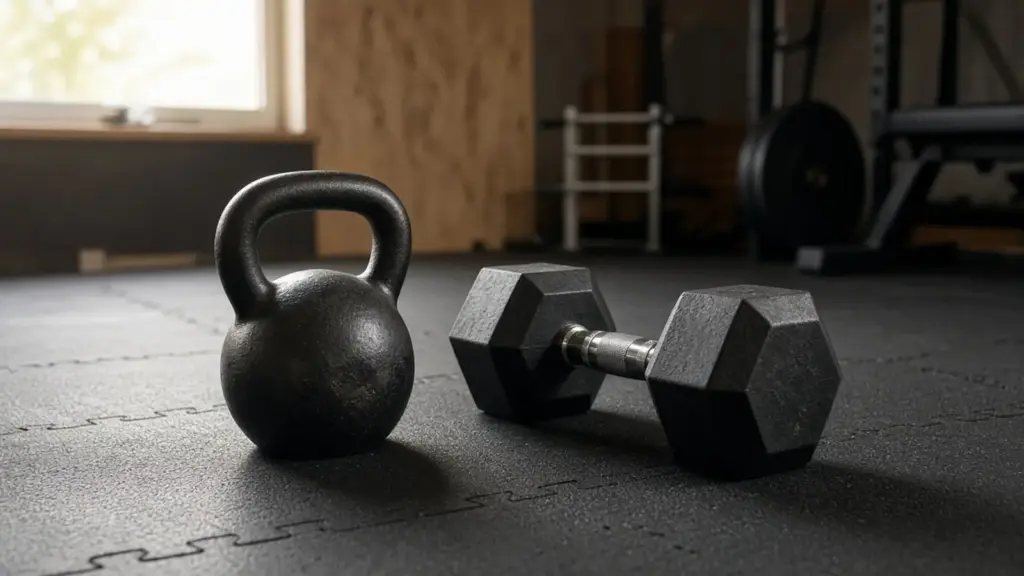
Image: AI-generated (Fibody)
Kettlebells vs Dumbbells: Which Tool for Which Goal?
As an Amazon Associate I earn from qualifying purchases. Affiliate disclosure
Key takeaways
- Six weeks of twice-weekly kettlebell swings improved half-squat strength and jump height about as much as jump-squat training in one small trial. Evidence: Limited
- In a 6-week comparison, weightlifting with heavy barbell lifts increased squat strength more than kettlebell training; jump height and body composition changed similarly. Evidence: Limited
- 12 minutes of continuous swings pushed heart rate to about 87% of maximum, but oxygen use to only about 65% of maximum, so heart rate overstates the aerobic load. Evidence: Limited
- A scoping review of 99 publications rated the overall evidence for kettlebell training as low to very low; most studies are small and short. Evidence: Limited
Kettlebells and dumbbells overlap a lot: you can squat, press and row with either. The difference shows up in swinging, fast hip-driven movements, which is where kettlebells shine, and in fine-grained loading, which is where adjustable dumbbells are easier.
The research on kettlebells is small, so this roundup sticks to what the trials actually measured and is clear about the gaps.
Evidence at a glance
| Question | What the evidence suggests | Evidence level | Main sources |
|---|---|---|---|
| Do swings build strength and power? | Yes in short trials: half-squat 1RM and jump height improved. | Limited | Lake 2012 [2] |
| Kettlebells vs heavy barbell lifts for max strength? | Heavy lifting gave bigger squat strength gains. | Limited | Otto 2012 [3] |
| Are swings good cardio? | They raise heart rate a lot; oxygen use is moderate to high. | Limited | Farrar 2010 [4] |
| Can they help neck or back pain at work? | One trial in workers with pain found less pain after 8 weeks. | Limited | Jay 2011 [5] |
| How strong is the overall evidence? | Low to very low; mostly small, short studies. | Limited | Meigh 2019 [1] |
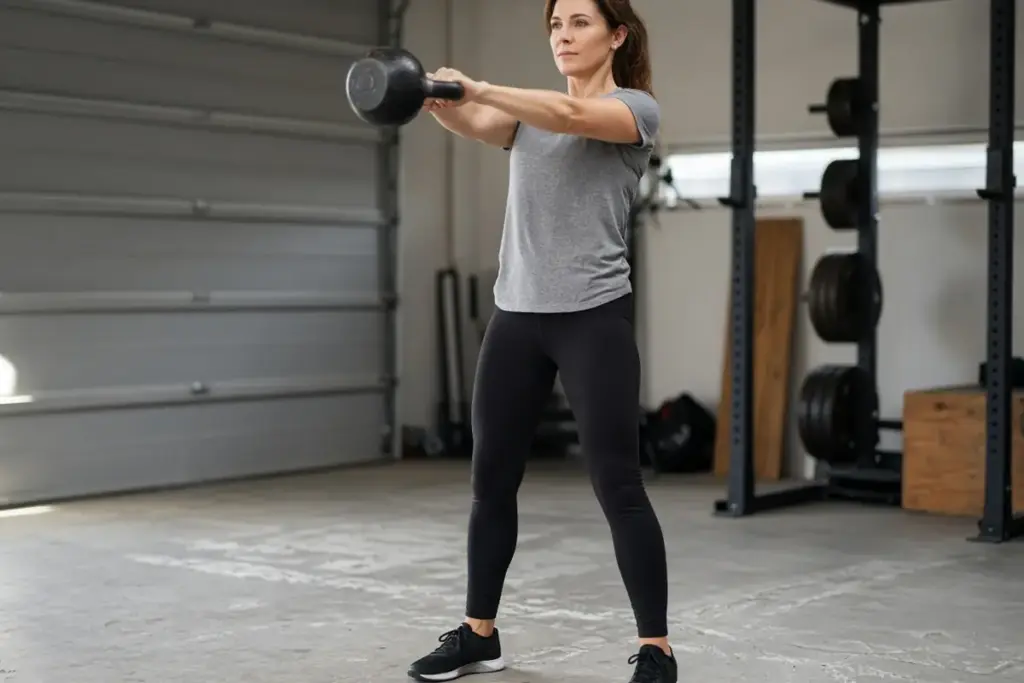
Kettlebells and dumbbells side by side
| Kettlebell | Dumbbell | |
|---|---|---|
| Best at | Swings, cleans, snatches, carries, goblet squats | Presses, rows, curls, lunges, isolation work |
| Load steps | Usually big jumps between bells | Small steps, especially adjustable sets |
| Heart-rate demand | High with continuous swings | Depends on the circuit |
| Learning curve | Swings need coaching on the hip hinge | Most moves are familiar |
| Space | One or two bells go a long way | An adjustable pair replaces a rack |
How it works
The swing is a fast hip hinge. You drive the bell forward with the hips, not the arms. A lab study found swings produce power comparable to jump squats and a high net impulse, which suggests they train the ability to apply force quickly [6].
The handle changes the lever. A kettlebell’s weight sits below and in front of the hand, which suits swinging and carrying. A dumbbell’s weight sits on either side of the hand, which is steadier for pressing and curling.
Progression is the practical difference. Strength keeps improving when the load rises gradually [7]. Big jumps between bell sizes make that harder; adjustable dumbbells make it easier.
What the research says
In a 6-week trial, 21 healthy men did kettlebell swings twice a week (12 rounds of 30 seconds on, 30 seconds off) or jump-squat training. Half-squat 1RM rose by 9.8% and vertical jump height by 19.8% overall, with no significant difference between groups [2].
A different 6-week trial in 30 men compared kettlebell training (swings, accelerated swings and goblet squats) with weightlifting plus heavy back squats. Both improved strength and power, but squat strength rose more with weightlifting. Vertical jump and body composition did not differ between groups [3].
When 10 college-aged men did as many two-handed swings as possible in 12 minutes with a 16 kg bell, they averaged about 87% of maximum heart rate but only about 65% of VO2max, so heart rate overstated the aerobic demand [4].
In 40 workers with musculoskeletal pain, 8 weeks of kettlebell training 3 times a week reduced neck/shoulder and low-back pain versus a control group and improved back-extensor strength, but did not change aerobic fitness [5].
A 2019 scoping review identified 99 publications, found effect sizes were typically trivial to small and rated confidence in reported effects as low to very low [1].
Limits of the research
- Small samples: 10–40 people per study, mostly young men [2][3][4].
- Short duration: 6–8 weeks.
- Few head-to-head trials compare kettlebells directly with dumbbells; most compare with barbell or jump training.
- Low certainty overall, according to the scoping review [1], whose lead author declared that he is a kettlebell instructor.
Who should be careful
- New to swings: learn the hip hinge first; rounding the back or lifting with the arms is a common error.
- Low-back pain or a recent injury: get advice from a physiotherapist before ballistic work.
- Shared spaces: clear the area in front and behind you; a dropped bell travels.
- Heart or blood pressure conditions: continuous swings push heart rate high [4]; check with your doctor about intensity.
How to apply this at home
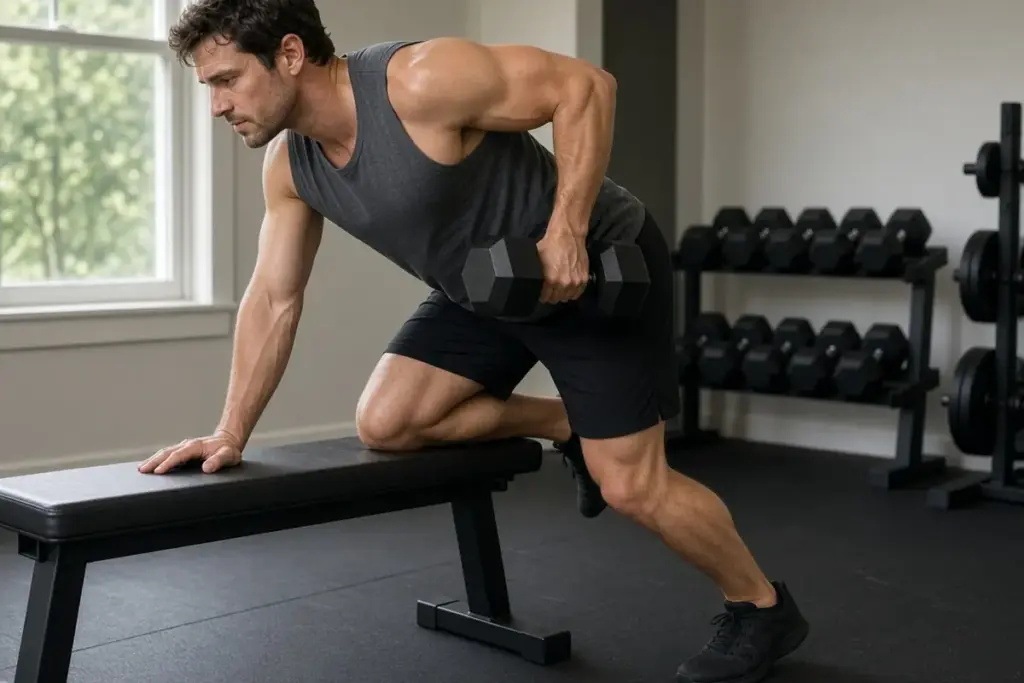
- Choose by goal. Power and conditioning: a kettlebell for swings. General strength and muscle: adjustable dumbbells with small steps.
- Start light and learn the swing from a coach or a trusted video; film yourself from the side.
- Try a simple swing block like the studies: 30 seconds on, 30 seconds off, building up gradually [2].
- Keep the heavy basics for maximum strength; heavier squats and presses won the head-to-head [3]. The Workout Planner can mix both.
- Don’t judge swing cardio by heart rate alone [4]. Use the Heart Rate Zone Calculator as a rough guide together with how hard it feels.
- Progress gradually: more reps or rounds first, then a heavier bell [7].
Log swings, rounds and weights with a free Fibody membership.
Frequently asked questions
Can kettlebells replace a full set of weights?
For general fitness, a couple of bells cover a lot. For maximum strength, heavier traditional lifts did better in one trial [3].
What weight should I start with?
The swing studies used 12–16 kg in trained young men [2][4]. Most beginners should start lighter and learn the technique first.
Are kettlebell swings bad for your back?
In one trial in workers with back pain, kettlebell training reduced low-back pain [5]. Technique and gradual progression matter; get advice if you have a back condition.
Do swings count as cardio?
They raise heart rate and oxygen use substantially [4], so they can be part of conditioning, but they do not replace all aerobic training.
Related on Fibody
- Tool: Workout Planner and Heart Rate Zone Calculator.
- Method: Strength training and HIIT at home.
- Guide: How to choose adjustable dumbbells for a small apartment.
- Shop: Home strength equipment.
More in Equipment Comparisons
References
- Meigh NJ, Keogh JWL, Schram B, Hing WA. Kettlebell training in clinical practice: a scoping review. BMC Sports Sci Med Rehabil. 2019;11:19. PMID 31497302. pubmed.ncbi.nlm.nih.gov/31497302/ (accessed 31 October 2026)
- Lake JP, Lauder MA. Kettlebell swing training improves maximal and explosive strength. J Strength Cond Res. 2012;26(8):2228-33. PMID 22580981. pubmed.ncbi.nlm.nih.gov/22580981/ (accessed 31 October 2026)
- Otto WH 3rd, Coburn JW, Brown LE, Spiering BA. Effects of weightlifting vs. kettlebell training on vertical jump, strength, and body composition. J Strength Cond Res. 2012;26(5):1199-202. PMID 22344061. pubmed.ncbi.nlm.nih.gov/22344061/ (accessed 31 October 2026)
- Farrar RE, Mayhew JL, Koch AJ. Oxygen cost of kettlebell swings. J Strength Cond Res. 2010;24(4):1034-6. PMID 20300022. pubmed.ncbi.nlm.nih.gov/20300022/ (accessed 31 October 2026)
- Jay K, Frisch D, Hansen K, et al. Kettlebell training for musculoskeletal and cardiovascular health: a randomized controlled trial. Scand J Work Environ Health. 2011;37(3):196-203. PMID 21107513. pubmed.ncbi.nlm.nih.gov/21107513/ (accessed 31 October 2026)
- Lake JP, Lauder MA. Mechanical demands of kettlebell swing exercise. J Strength Cond Res. 2012;26(12):3209-16. PMID 22207261. pubmed.ncbi.nlm.nih.gov/22207261/ (accessed 31 October 2026)
- American College of Sports Medicine. Position stand: Progression models in resistance training for healthy adults. Med Sci Sports Exerc. 2009;41(3):687-708. PMID 19204579. pubmed.ncbi.nlm.nih.gov/19204579/ (accessed 31 October 2026)
Medical disclaimer. This article summarises published research and public-health guidance for general information. It is not medical advice and does not replace a doctor, physiotherapist or other qualified professional. Stop exercising and seek medical help if you have chest pain, fainting, severe shortness of breath or sharp pain. See our Medical Disclaimer.
Last reviewed on 31 October 2026 · Next scheduled review: 31 October 2027 · Changes: First version.