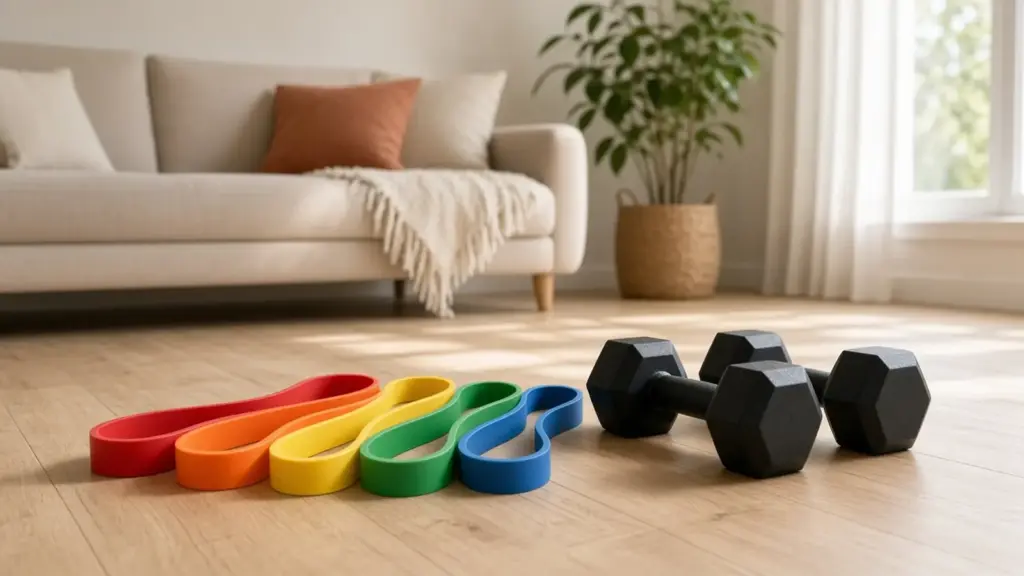
Image: AI-generated (Fibody)
Resistance Bands vs Dumbbells: Can Bands Build Real Strength?
As an Amazon Associate I earn from qualifying purchases. Affiliate disclosure
Key takeaways
- In a 2019 meta-analysis of 8 studies, training with elastic bands or tubes gave similar strength gains to training with machines or dumbbells, for both upper and lower body. Evidence: Moderate
- In older adults, progressive band training clearly improved muscle strength compared with no training. Evidence: Moderate
- When effort is matched (for example a hard 6-rep set), a banded push-up and a bench press produced similar strength gains in one small trial. Evidence: Limited
- Dumbbells make load easy to measure and add in small steps; bands are harder to quantify, so progression takes more care. Evidence: Limited
Resistance bands are cheap, light and fit in a drawer. Dumbbells take up more room but make it obvious how much you are lifting. If you are setting up a small home gym, the real question is whether bands can make you as strong as weights.
This roundup looks at a meta-analysis that compared elastic and conventional resistance head to head, a review of band training in older adults, and a trial that matched effort between a banded push-up and the bench press.
Evidence at a glance
| Question | What the evidence suggests | Evidence level | Main sources |
|---|---|---|---|
| Do bands build as much strength as weights? | Similar strength gains in pooled studies, upper and lower body. | Moderate | Lopes 2019 [1] |
| Do bands work for older adults? | Yes: large strength gains vs no training in healthy older adults; smaller in people with a disease. | Moderate | Martins 2013 [2] |
| Does matched effort matter more than the tool? | A hard banded push-up and a bench press at the same rep target gave similar gains. | Limited | Calatayud 2015 [3] |
| How should you progress? | Gradually increase load or difficulty over time, whatever the tool. | Strong (guideline) | ACSM 2009 [4] |
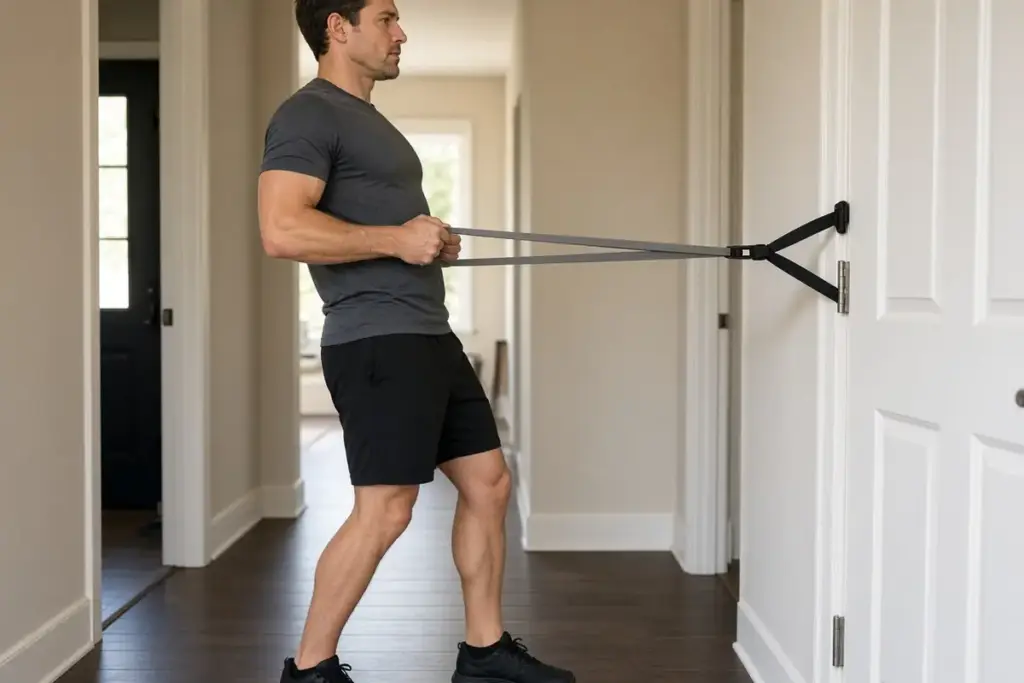
Bands and dumbbells side by side
| Resistance bands | Dumbbells (fixed or adjustable) | |
|---|---|---|
| How resistance works | Tension rises as the band stretches | Same weight through the whole lift |
| Measuring load | Hard: depends on band, length and stretch | Easy: the number is on the plate |
| Small progressions | Change band, shorten it, add reps or slow the tempo | Add a small plate or step up a setting |
| Space and travel | Fits in a bag | Needs floor space; adjustable sets save room |
| Heavy lower-body work | Possible but awkward to load very heavily | Straightforward up to the set’s maximum |
How it works
Muscles respond to effort, not to the label on the equipment. Strength improves when muscles work against a challenging resistance and that challenge increases over time [4]. A band and a dumbbell are two ways of supplying it.
The resistance curve differs. A band is easiest at the start of a movement and hardest at full stretch, while a dumbbell’s load stays the same. That changes where in the movement the exercise feels hard.
Progression is where they differ most. With dumbbells you can see and log the number. With bands you need a system: note the band colour, the anchor point and the reps.
What the research says
A 2019 systematic review and meta-analysis pooled 8 studies comparing elastic devices (tubes and bands) with conventional devices (weight machines and dumbbells). It found no difference in strength gains for the lower limbs (SMD −0.11, 95% CI −0.40 to 0.19) or upper limbs (SMD 0.09, 95% CI −0.18 to 0.35), and concluded that elastic training can promote similar strength gains across different populations and protocols [1].
In older adults, a 2013 meta-analysis of 11 studies (834 people aged 60–79) found progressive band training had large effects on muscle strength in healthy older adults (SMD 1.30) and in those with some functional limitation (SMD 1.01), and a moderate effect in people with a disease (SMD 0.54). The authors noted that little was reported about training intensity [2].
Effort may matter more than the tool. In a 5-week trial in trained students, a push-up with elastic bands and a bench press, both set so that 6 reps were hard, produced similar gains in bench press strength [3].
Limits of the research
- Few, small studies: the main meta-analysis included only 8 trials [1].
- Short programmes: most lasted weeks, not years, so very long-term progress with bands alone is less clear.
- Intensity is poorly reported in band studies, which makes it hard to copy their programmes exactly [2].
- Strength, not muscle size: the head-to-head meta-analysis looked at strength outcomes [1].
Who should be careful
- Anyone using old or nicked bands: check for tears before each session; a snapping band can hit your face or eyes.
- Door and anchor set-ups: use a proper anchor and make sure the door closes away from you.
- Heavy dumbbells overhead or over the face: choose a load you can control and lower it safely.
- Joint pain, a recent injury or a medical condition: ask a doctor or physiotherapist which exercises suit you.
How to apply this at home
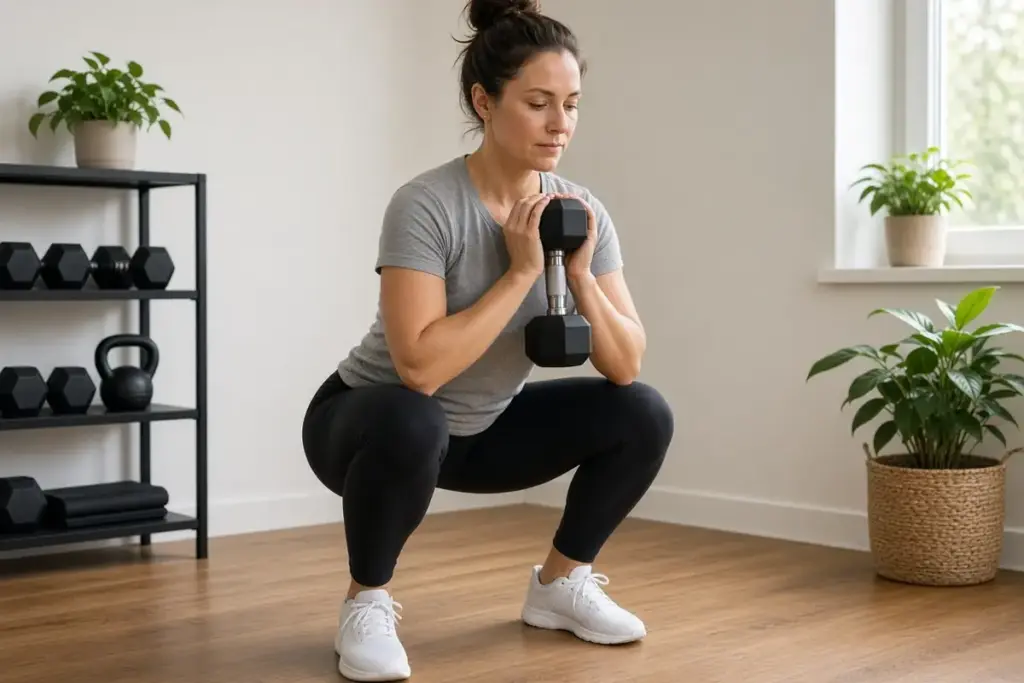
- Pick by space and goal. Bands for travel and tight spaces; dumbbells if you want simple, measurable progress, especially for legs.
- Train hard enough. Choose a band or weight that makes the last 1–3 reps of each set a real effort.
- Log it. For bands, note colour, anchor point, stance and reps; for dumbbells, the weight and reps.
- Progress gradually by adding reps, then moving to a heavier band or weight [4].
- Cover the whole body on at least 2 days a week, as guidelines advise [5]. The Workout Planner builds sessions around the equipment you have.
- Estimate dumbbell loads for a rep target with the One-Rep Max Calculator.
Keep a simple log of your bands, weights and reps with a free Fibody membership.
Frequently asked questions
Can I build muscle with only bands?
Strength gains with bands were similar to conventional weights in pooled studies [1]. The challenge is making sets hard enough and progressing over time.
Are bands good for beginners and older adults?
Band training clearly improved strength in older adults [2]. Bands are light and easy to store, which helps many people start.
Why do dumbbells feel harder at the bottom of a curl and bands at the top?
Band tension increases as it stretches, while a dumbbell’s weight stays constant, so the hardest point of the movement shifts.
Should I combine both?
Many people do: dumbbells for the main lifts and bands for warm-ups, travel or extra sets.
Related on Fibody
- Tool: Workout Planner and One-Rep Max Calculator.
- Method: Strength training and Calisthenics.
- Guide: How to choose adjustable dumbbells for a small apartment.
- Shop: Home strength equipment.
More in Equipment Comparisons
References
- Lopes JSS, Machado AF, Micheletti JK, de Almeida AC, Cavina AP, Pastre CM. Effects of training with elastic resistance versus conventional resistance on muscular strength: a systematic review and meta-analysis. SAGE Open Med. 2019;7:2050312119831116 (erratum 2020). PMID 30815258. pubmed.ncbi.nlm.nih.gov/30815258/ (accessed 31 October 2026)
- Martins WR, de Oliveira RJ, Carvalho RS, et al. Elastic resistance training to increase muscle strength in elderly: a systematic review with meta-analysis. Arch Gerontol Geriatr. 2013;57(1):8-15. PMID 23562413. pubmed.ncbi.nlm.nih.gov/23562413/ (accessed 31 October 2026)
- Calatayud J, et al. Bench press and push-up at comparable levels of muscle activity results in similar strength gains. J Strength Cond Res. 2015;29(1):246-53. PMID 24983847. pubmed.ncbi.nlm.nih.gov/24983847/ (accessed 31 October 2026)
- American College of Sports Medicine. Position stand: Progression models in resistance training for healthy adults. Med Sci Sports Exerc. 2009;41(3):687-708. PMID 19204579. pubmed.ncbi.nlm.nih.gov/19204579/ (accessed 31 October 2026)
- Bull FC, Al-Ansari SS, Biddle S, et al. World Health Organization 2020 guidelines on physical activity and sedentary behaviour. Br J Sports Med. 2020;54(24):1451-62. PMID 33239350. pubmed.ncbi.nlm.nih.gov/33239350/ (accessed 31 October 2026)
Medical disclaimer. This article summarises published research and public-health guidance for general information. It is not medical advice and does not replace a doctor, physiotherapist or other qualified professional. Stop exercising and seek medical help if you have chest pain, fainting, severe shortness of breath or sharp pain. See our Medical Disclaimer.
Last reviewed on 31 October 2026 · Next scheduled review: 31 October 2027 · Changes: First version.