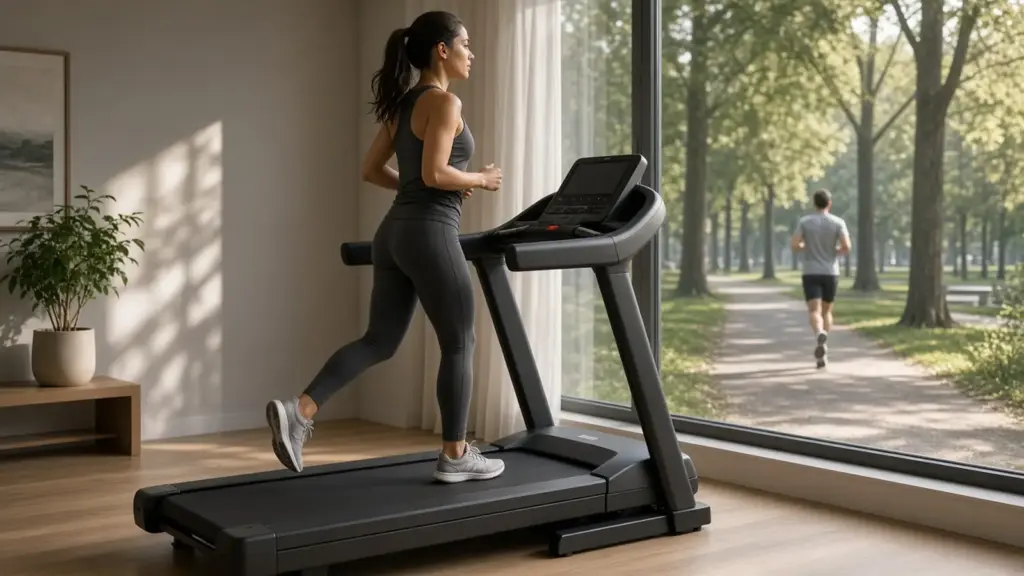
Image: AI-generated (Fibody)
Treadmill vs Outdoor Running: Effort, Impact and Injury Risk
As an Amazon Associate I earn from qualifying purchases. Affiliate disclosure
Key takeaways
- At submaximal speeds, oxygen use is similar on a treadmill at 0% or 1% grade and outdoors, across 34 crossover studies. Evidence: Moderate
- A 1% treadmill incline matched the energy cost of level road running at about 10.5–18 km/h (2.92–5.0 m/s) in one classic study of trained runners. Evidence: Limited
- Running mechanics are largely comparable, although the foot lands flatter on a treadmill (about 10° lower foot angle at footstrike). Evidence: Moderate
- Endurance performance was poorer on a motorised treadmill than overground, and heart rate and perceived effort differed depending on speed. Evidence: Moderate
Many runners feel that a treadmill kilometre is either easier or harder than one outside. Both can be true: the belt removes air resistance and terrain, but it also changes how pace, heart rate and effort relate to each other.
This roundup uses two meta-analyses of crossover studies, in which the same people ran both ways, and the study behind the popular “set it to 1%” advice.
Evidence at a glance
| Question | What the evidence suggests | Evidence level | Main sources |
|---|---|---|---|
| Is oxygen use the same? | Similar at submaximal speeds at 0% or 1% grade. | Moderate | Miller 2019 [1] |
| Does a 1% incline make it “equal”? | It matched road running energy cost at 2.92–5.0 m/s in trained men. | Limited | Jones & Doust 1996 [3] |
| Is running form the same? | Largely comparable; flatter foot at landing on the treadmill. | Moderate | Van Hooren 2020 [2] |
| Do heart rate and effort match? | Higher at faster and lower at slower submaximal speeds on the treadmill. | Moderate | Miller 2019 [1] |
| Is endurance performance the same? | Poorer on a motorised treadmill. | Moderate | Miller 2019 [1] |

Treadmill and outdoor running side by side
| Treadmill | Outdoors | |
|---|---|---|
| Air resistance | None (use about 1% incline) | Yes, more at faster speeds |
| Pace control | Exact and steady | You set it; terrain and wind vary |
| Weather and light | Not an issue | Heat, cold, ice and darkness matter |
| Terrain variety | Flat or set inclines | Hills, turns, uneven ground |
| Race-specific practice | Less specific | More specific |
How it works
No headwind indoors. Outdoors you push through air; on a treadmill you don’t, which lowers the energy cost. A slight incline adds that cost back [3].
The belt moves under you. Mechanics are mostly the same, but foot angle at footstrike is about 10° lower and contact time slightly longer on a treadmill [2].
Pace feels different. Perceived effort and heart rate on the treadmill differ from outdoors in a speed-dependent way [1], so the same pace number may not feel the same.
What the research says
In the 1996 study, nine trained male runners ran at six speeds on a level road and on a treadmill at 0–3% grade. A 1% grade best matched the oxygen cost of outdoor running across 2.92–5.0 m/s (about 10.5–18 km/h) over runs of about 5 minutes [3].
A 2019 meta-analysis of 34 crossover studies found similar oxygen uptake but lower blood lactate during submaximal motorised treadmill running at 0% and 1% grade than overground. Heart rate and perceived exertion were higher at faster and lower at slower submaximal speeds on the treadmill. Endurance performance was poorer on the treadmill (SMD −0.50), while sprint performance was not significantly different [1].
A 2020 meta-analysis of 33 studies (494 participants) found most biomechanical outcomes did not differ. On the treadmill, foot-ground angle at footstrike was 9.8° lower, contact time 5 ms longer and vertical movement of the centre of mass slightly smaller; most of these differences were rated low-certainty evidence [2].
Limits of the research
- Short bouts: many lab studies used runs of a few minutes, not long sessions.
- Trained, healthy adults: results may not apply to beginners, older adults or people with injuries.
- Treadmills vary: belt stiffness, motor power and calibration differ between machines.
- Low-certainty biomechanics: most differences in form were rated low or very low GRADE evidence [2].
Who should be careful
- New to treadmills: start slowly, use the safety clip and don’t step off a moving belt.
- Children and pets at home: unplug or lock the treadmill when not in use.
- Balance problems or dizziness: use the handrails and ask a health professional before running.
- Heart or lung conditions, or new chest pain: stop and seek medical advice before continuing.
- Outdoors: heat, ice and traffic carry their own risks; adjust pace and route.
How to apply this at home
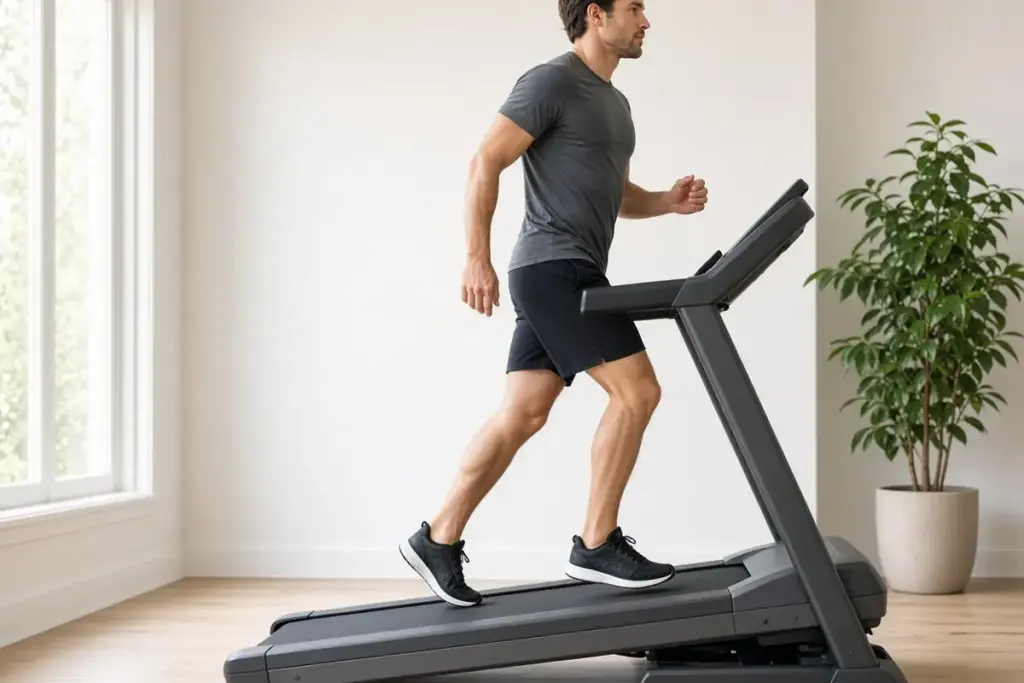
- Set the incline to about 1% if you want treadmill runs to roughly match flat outdoor effort [3].
- Run by effort and heart rate, not pace alone [1]. The Heart Rate Zone Calculator gives a starting point.
- Expect long runs to feel harder on a treadmill; endurance performance was lower there [1].
- Do some outdoor runs before a road race so your legs get used to turns, camber and wind.
- Use the treadmill for precision: intervals, bad weather, dark evenings.
- Plan a mixed week with the Workout Planner and keep to the weekly activity targets [4][5].
Log indoor and outdoor runs together with a free Fibody membership.
Frequently asked questions
Is treadmill running easier?
At 0% grade it costs a bit less energy than road running, especially at faster speeds, because there is no air resistance [3]. Many people still find it harder mentally.
Is 1% incline always right?
It was best across the speeds tested in trained men [3]. At slow jogging speeds the difference is small anyway.
Is a treadmill easier on the joints?
Mechanics are largely comparable [2]. The evidence does not show a clear joint-protection advantage.
Is injury risk lower on a treadmill?
We did not find trials comparing injury rates between the two. The biomechanics review found most measures were similar, with small differences such as a flatter foot at footstrike and slightly lower peak push-off force on the treadmill (low to very low certainty) [2]. Whichever you choose, increase your running volume gradually.
Related on Fibody
- Tool: Heart Rate Zone Calculator and Workout Planner.
- Method: Running.
- Guide: Treadmill vs Exercise Bike vs Rowing Machine.
- Shop: Home cardio and heart-rate wearables.
More in Equipment Comparisons
References
- Miller JR, Van Hooren B, Bishop C, Buckley JD, Willy RW, Fuller JT. A systematic review and meta-analysis of crossover studies comparing physiological, perceptual and performance measures between treadmill and overground running. Sports Med. 2019;49(5):763-82. PMID 30847825. pubmed.ncbi.nlm.nih.gov/30847825/ (accessed 31 October 2026)
- Van Hooren B, Fuller JT, Buckley JD, et al. Is motorized treadmill running biomechanically comparable to overground running? A systematic review and meta-analysis of cross-over studies. Sports Med. 2020;50(4):785-813. PMID 31802395. pubmed.ncbi.nlm.nih.gov/31802395/ (accessed 31 October 2026)
- Jones AM, Doust JH. A 1% treadmill grade most accurately reflects the energetic cost of outdoor running. J Sports Sci. 1996;14(4):321-7. PMID 8887211. pubmed.ncbi.nlm.nih.gov/8887211/ (accessed 31 October 2026)
- Garber CE, et al.; American College of Sports Medicine. Position stand: Quantity and quality of exercise for developing and maintaining cardiorespiratory, musculoskeletal, and neuromotor fitness in apparently healthy adults. Med Sci Sports Exerc. 2011;43(7):1334-59. PMID 21694556. pubmed.ncbi.nlm.nih.gov/21694556/ (accessed 31 October 2026)
- Bull FC, Al-Ansari SS, Biddle S, et al. World Health Organization 2020 guidelines on physical activity and sedentary behaviour. Br J Sports Med. 2020;54(24):1451-62. PMID 33239350. pubmed.ncbi.nlm.nih.gov/33239350/ (accessed 31 October 2026)
Medical disclaimer. This article summarises published research and public-health guidance for general information. It is not medical advice and does not replace a doctor, physiotherapist or other qualified professional. Stop exercising and seek medical help if you have chest pain, fainting, severe shortness of breath or sharp pain. See our Medical Disclaimer.
Last reviewed on 31 October 2026 · Next scheduled review: 31 October 2027 · Changes: First version.