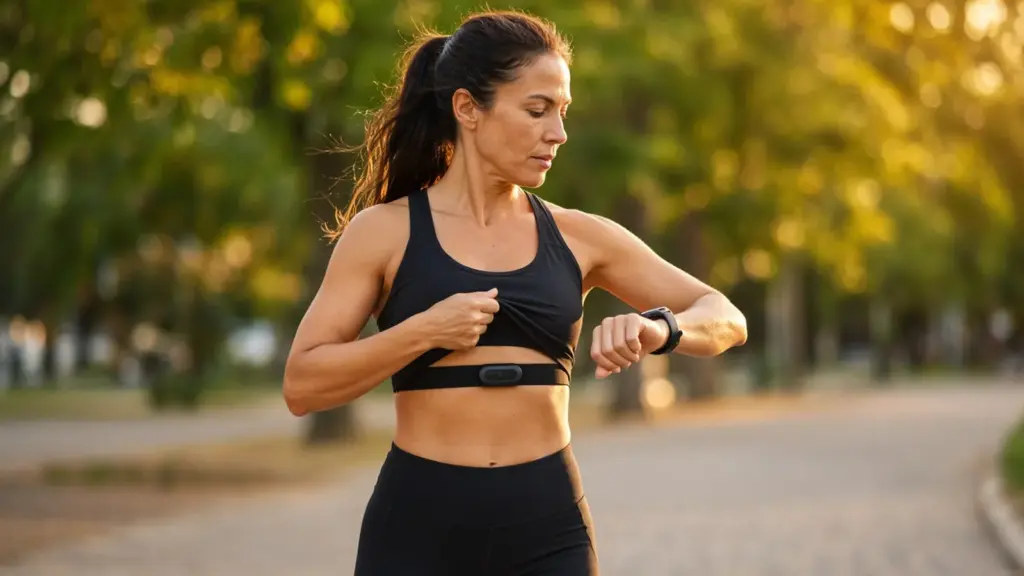
Image: AI-generated (Fibody)
Wrist vs Chest-Strap Heart Rate: How Accurate Are Fitness Wearables?
As an Amazon Associate I earn from qualifying purchases. Affiliate disclosure
Key takeaways
- Across 44 studies, wrist heart-rate readings were on average within about 1 beat per minute of reference devices at rest and on a treadmill. Evidence: Moderate
- Accuracy dropped during resistance training (about 7 bpm lower on average) and cycling, and the error grew as heart rate rose. Evidence: Moderate
- Calorie (energy expenditure) estimates from wearables varied widely between devices and activities; treat them as rough guides. Evidence: Moderate
- You do not need a device to judge intensity: the talk test and a 0–10 effort scale are accepted by public-health agencies. Evidence: Strong
Most smartwatches and fitness bands measure heart rate with light: an optical sensor (photoplethysmography, or PPG) shines LEDs into the skin of your wrist and reads changes in blood flow. A chest strap instead picks up the electrical signal of the heart, much like a simplified ECG. Both show a number on your screen, but they do not measure the same thing in the same way.
So how far can you trust the wrist? Research summaries suggest: quite well at rest and in steady cardio, less well when you lift weights, cycle or change pace quickly, and much less for calories.
Evidence at a glance
| Question | What the evidence suggests | Evidence level | Main sources |
|---|---|---|---|
| Is wrist heart rate accurate at rest and walking or running? | Average differences from reference devices were close to zero (about 0–0.5 bpm). | Moderate | Meta-analysis of 44 studies [1] |
| Is it accurate during weight training or cycling? | Less so: on average about 7 bpm low in resistance training and about 4.5 bpm low in cycling, with more error at higher heart rates. | Moderate | Meta-analysis [1] |
| Are calorie estimates accurate? | Accuracy varied a lot between devices and activities; devices combining heart rate with movement did better. | Moderate | Meta-analysis of 60 studies [2] |
| Do I need a heart-rate monitor to train at the right intensity? | No: the talk test and a 0–10 effort scale are accepted ways to judge intensity. | Strong | CDC, ACSM [3][4] |

Wrist sensor vs chest strap side by side
| Wrist optical sensor (watch or band) | Chest strap (electrical) | |
|---|---|---|
| What it measures | Blood-volume changes under the skin, converted into a pulse rate. | The heart’s electrical activity, closer to how an ECG works. |
| Steady cardio (walking, easy running) | Usually close to reference readings. | Commonly used as the reference in studies. |
| Lifting, intervals, cycling | More error, especially with wrist flexion, grip and fast changes. | Less affected by arm movement. |
| Comfort and convenience | Worn all day; also tracks sleep and steps. | Only worn during training; some find it uncomfortable. |
| Extra cost | Built into the watch you may already own. | A separate purchase that pairs with a watch, app or machine. |
How it works
An optical sensor detects tiny changes in how much light is absorbed as blood pulses through the wrist. Anything that disturbs that signal can cause errors: loose fit, wrist movement, tensing your forearm on a grip, cold skin, sweat, or a rapidly changing heart rate. Algorithms filter out the noise, which is why results differ between brands and software versions.
A chest strap sits close to the heart and detects its electrical signal, so arm movements matter far less. That is why studies often use chest straps or ECG as the reference against which watches are tested [1].
Calories are a different problem. No wearable measures energy use directly; it estimates it from heart rate, movement and your personal data. Small errors in each input add up [2].
What the research says
Heart rate. A 2020 systematic review and meta-analysis by Zhang and colleagues pooled 44 studies covering 15 brands of wrist-worn PPG devices, comparing them with ECG or chest straps [1]. Average differences from the reference were:
- about −0.40 bpm during sleep and −0.01 bpm at rest;
- about −0.51 bpm on a treadmill;
- about −4.55 bpm during cycling;
- about −7.26 bpm during resistance training, where the error grew by roughly 3 bpm for every 10 bpm increase in heart rate.
The authors judged wrist devices to have acceptable validity for heart rate in most common activities, with less accuracy in resistance training and cycling [1]. “On average” matters: an average close to zero can hide individual readings that are well above or below the true value.
Energy expenditure. A 2020 meta-analysis by O’Driscoll and colleagues included 60 studies of activity monitors [2]. Accuracy varied by device and activity, with large differences between studies. Monitors that combined heart rate with movement data generally estimated energy use better than those using movement alone [2].
Do you need a number at all? The CDC describes simple ways to judge intensity [3]. On a 0–10 scale of effort, moderate activity is around 5–6 and vigorous activity starts at about 7–8. With the talk test, during moderate activity you can talk but not sing; during vigorous activity you can say only a few words without pausing for breath [3]. The ACSM position stand adds that an exercise programme should be adapted to each person’s health status, exercise responses and goals [4], which is easier when you watch how you feel and not only a number.
Intensity matters because the WHO guidelines are written in moderate and vigorous minutes: 150–300 minutes of moderate or 75–150 minutes of vigorous aerobic activity a week, or an equivalent combination [5]. A monitor is one way to check which category a session falls into; it is not required to meet the guidelines.
Limits of the research
- Technology changes fast. Studies tested models that may since have been updated or replaced; newer sensors and software may perform differently.
- Averages hide individuals. Pooled results do not show how a particular watch behaves on your wrist.
- Different reference methods and protocols make studies hard to compare, especially for calories [2].
- Skin tone, tattoos and fit may affect optical sensors; the meta-analyses could not fully answer how much.
Who should be careful
- People with heart conditions or on heart-rate-lowering medicines (for example beta-blockers): standard heart-rate zones may not apply. Ask your doctor what range is safe for you.
- Anyone relying on a watch to detect problems. A consumer device is not a diagnostic tool. Chest pain, fainting, unusual breathlessness or palpitations need medical attention whatever your watch says.
- People using calorie burn to decide how much to eat. Calorie estimates can be well off [2]; base intake on trends in body weight over weeks rather than one day’s figure.
How to apply this at home
- Find your zones first. The free Heart Rate Zone Calculator estimates maximum heart rate from age (208 − 0.7 × age) and, if you add your resting heart rate, uses heart-rate reserve. It shows moderate and vigorous bands based on ACSM ranges. These are estimates; real maximum heart rate varies.
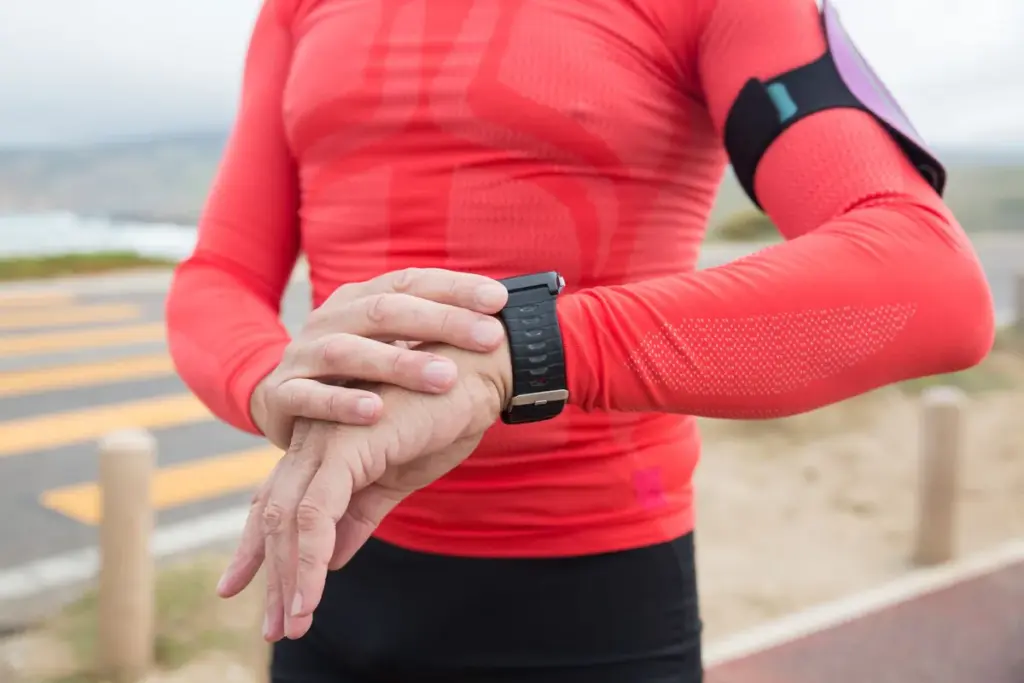
- Use a wrist sensor for steady cardio, such as walking, easy running or long rowing sessions, and wear it snug, a finger’s width above the wrist bone.
- Consider a chest strap for intervals, cycling or strength circuits, where wrist readings are less accurate [1]. Many watches can pair with one.
- Cross-check with effort. If the watch says “easy” but you can only say a few words, trust the talk test [3].
- Do not eat back watch calories. Estimate daily needs with the TDEE Calculator and adjust using your weight trend.
Save your zones and track how your resting heart rate changes with a free Fibody membership.
Frequently asked questions
Is a chest strap more accurate than a smartwatch?
Chest straps are generally used as the reference in validation studies. Wrist sensors were close to them at rest and in steady cardio but less accurate in resistance training and cycling [1].
Why does my watch show a low heart rate when I lift weights?
Gripping and flexing the wrist disturbs the optical signal. On average, wrist readings were about 7 bpm low during resistance training, and the error increased at higher heart rates [1].
How accurate are calories burned on a fitness tracker?
Not very consistent: accuracy varied widely between devices and activities [2]. Use them to compare your own sessions, not as an exact figure.
Can I train by feel instead?
Yes. The CDC’s talk test and 0–10 effort scale are simple, free ways to judge moderate and vigorous intensity [3].
Related on Fibody
- Tool: Heart Rate Zone Calculator.
- Method: Running and HIIT at home.
- Guide: Fitness Tracker vs Smartwatch vs Chest Strap: Which Should You Wear?
- Shop: Wearables.
More in Equipment Comparisons
References
- Zhang Y, Weaver RG, Armstrong B, Burkart S, Zhang S, Beets MW. Validity of wrist-worn photoplethysmography devices to measure heart rate: a systematic review and meta-analysis. J Sports Sci. 2020;38(17):2021-34. PMID 32552580. pubmed.ncbi.nlm.nih.gov/32552580/ (accessed 31 October 2026)
- O'Driscoll R, Turicchi J, Beaulieu K, et al. How well do activity monitors estimate energy expenditure? A systematic review and meta-analysis of the validity of current technologies. Br J Sports Med. 2020;54(6):332-40. PMID 30194221. pubmed.ncbi.nlm.nih.gov/30194221/ (accessed 31 October 2026)
- Centers for Disease Control and Prevention. How to Measure Physical Activity Intensity. Updated 4 December 2025. www.cdc.gov/physical-activity-basics/measuring/index.html (accessed 31 October 2026)
- Garber CE, et al.; American College of Sports Medicine. Position stand: Quantity and quality of exercise for developing and maintaining cardiorespiratory, musculoskeletal, and neuromotor fitness in apparently healthy adults. Med Sci Sports Exerc. 2011;43(7):1334-59. PMID 21694556. pubmed.ncbi.nlm.nih.gov/21694556/ (accessed 31 October 2026)
- Bull FC, Al-Ansari SS, Biddle S, et al. World Health Organization 2020 guidelines on physical activity and sedentary behaviour. Br J Sports Med. 2020;54(24):1451-62. PMID 33239350. pubmed.ncbi.nlm.nih.gov/33239350/ (accessed 31 October 2026)
Medical disclaimer. This article summarises published research and public-health guidance for general information. It is not medical advice and does not replace a doctor, physiotherapist or other qualified professional. Stop exercising and seek medical help if you have chest pain, fainting, severe shortness of breath or sharp pain. See our Medical Disclaimer.
Last reviewed on 31 October 2026 · Next scheduled review: 31 October 2027 · Changes: First version.