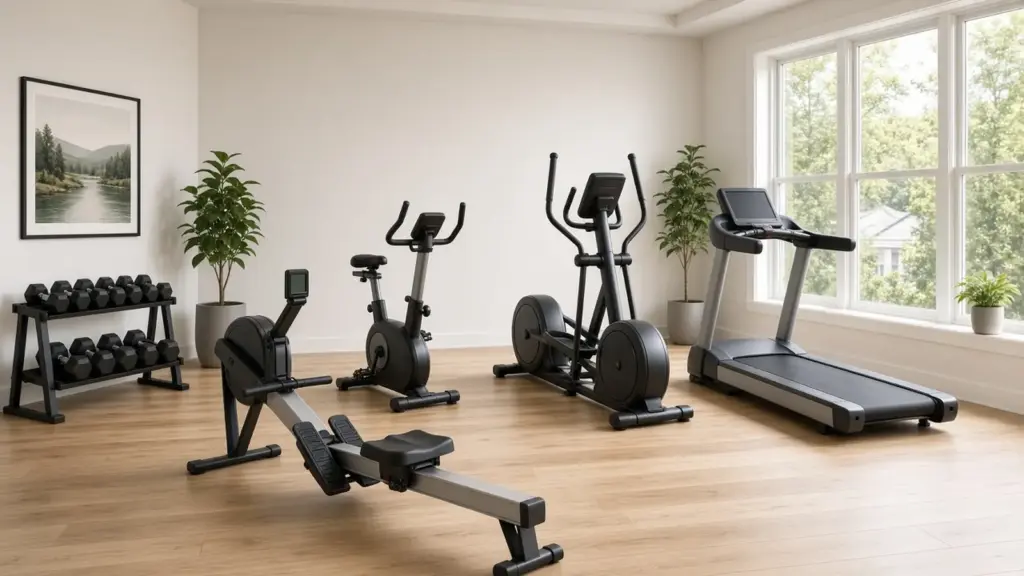
Image: AI-generated (Fibody)
Rower, Bike, Elliptical or Treadmill: Calories, Joint Load and Who Each Suits
As an Amazon Associate I earn from qualifying purchases. Affiliate disclosure
Key takeaways
- Any of the four machines can meet the weekly aerobic targets of 150–300 moderate or 75–150 vigorous minutes; effort matters more than the machine. Evidence: Strong
- Energy cost overlaps: the 2024 Compendium lists about 5.0 METs for moderate rowing or elliptical, 6.0 for moderate stationary cycling, and around 9 METs for running at 6 mph. Evidence: Moderate
- For knee or hip osteoarthritis, exercise is strongly recommended; the guideline does not single out one machine, so pick a low-impact option you tolerate. Evidence: Moderate
- Few trials compare these machines head to head for long-term health outcomes; choose the one you will use consistently. Evidence: Limited
Rowers, exercise bikes, ellipticals and treadmills all promise a great cardio workout. In practice each one can be easy or very hard depending on how you use it, so the useful comparison is about effort, impact, space and enjoyment.
This roundup uses the Compendium of Physical Activities, the standard reference for the energy cost of activities, plus physical-activity and osteoarthritis guidelines. It also notes where the research is thin.
Evidence at a glance
| Question | What the evidence suggests | Evidence level | Main sources |
|---|---|---|---|
| Which machine burns the most? | Energy cost overlaps; it depends mostly on effort or wattage. | Moderate | Compendium [1][2][3] |
| Do they all count toward guidelines? | Yes, at moderate or vigorous intensity. | Strong | WHO, ACSM [4][5] |
| Best for sore knees or hips? | Exercise is strongly recommended for osteoarthritis; no single machine is preferred. | Strong (guideline) | ACR/AF 2019 [6] |
| Which gives the best long-term results? | Few head-to-head trials; adherence matters most. | Limited | ACSM [5] |
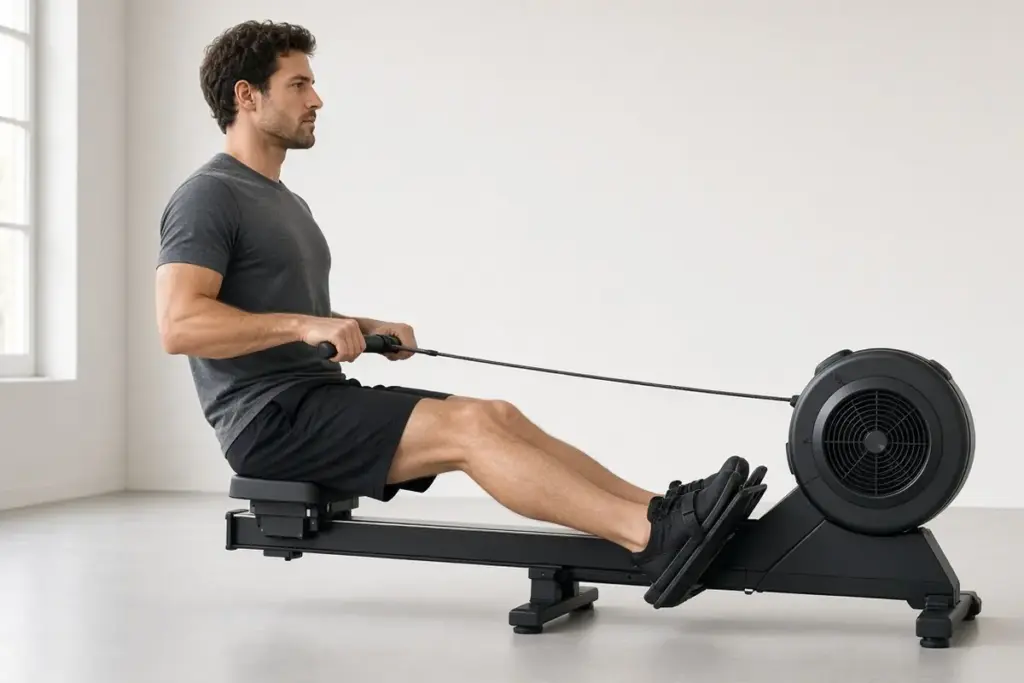
The four machines side by side
| Rower | Exercise bike | Elliptical | Treadmill | |
|---|---|---|---|---|
| Compendium METs (examples) | 5.0 moderate (<100 W); 7.3 vigorous | 6.0 at 90–100 W; 6.8 general | 5.0 moderate; 9.0 vigorous | 7.5 jogging; 9.3 running at 6 mph |
| Impact | Low | Low | Low | Higher (running) |
| Main muscles | Legs, back, arms | Legs | Legs, some arms | Legs |
| Technique needed | Moderate | Low | Low | Low (walking) to moderate |
| Space | Long; some fold or stand upright | Small | Medium to large | Large; some fold |
How it works
METs measure effort. One MET is roughly your energy use at rest. Moderate activity is about 3–5.9 METs and vigorous is 6 or more [5]. The Compendium lists typical MET values for hundreds of activities [1].
Intensity beats the machine. On the Compendium tables, stationary cycling ranges from 3.5 METs at 25–30 W to above 16 METs at more than 325 W, and rowing from 5.0 below 100 W to 14.0 at 200 W or more [2]. Each machine covers easy through very hard.
Impact and muscles differ. Running loads the legs with each landing; rowing, cycling and the elliptical keep the feet supported. Rowing also uses the back and arms.
What the research says
The 2024 Adult Compendium is the third update of the energy cost of human activities and is used to estimate energy expenditure in research and practice [1]. Its tables show overlapping ranges: moderate rowing and moderate elliptical both at 5.0 METs, stationary cycling at 90–100 W at 6.0, vigorous elliptical at 9.0 and running at 6–6.3 mph at 9.3 [2].
WHO and ACSM guidelines count any aerobic activity of moderate or vigorous intensity toward the weekly targets and do not favour one machine [4][5]. ACSM notes that enjoyment and convenience help people keep exercising [5].
For people with knee or hip osteoarthritis, the 2019 ACR/Arthritis Foundation guideline strongly recommends exercise, and tai chi for knee and hip OA. It calls for shared decision-making that accounts for each patient’s values, preferences and other conditions, rather than naming one best machine [6].
Limits of the research
- METs are averages: your actual energy use depends on body size, fitness and technique [1].
- Machine calorie displays are estimates and may not match lab measurements.
- Few head-to-head trials compare these four machines for long-term health.
- The 2024 Compendium covers adults aged 19–59; values for older adults were removed from it [1].
- Some Compendium values are estimated rather than measured; the site marks these [2].
Who should be careful
- Back pain: learn rowing technique first (legs, then body, then arms) and start easy.
- Knee or hip pain: try a bike or elliptical and keep effort moderate; ask a physiotherapist for advice [6].
- Balance problems: a recumbent bike is more stable than a treadmill.
- Heart conditions or new symptoms such as chest pain or unusual breathlessness: stop and get medical advice before continuing.
How to apply this at home
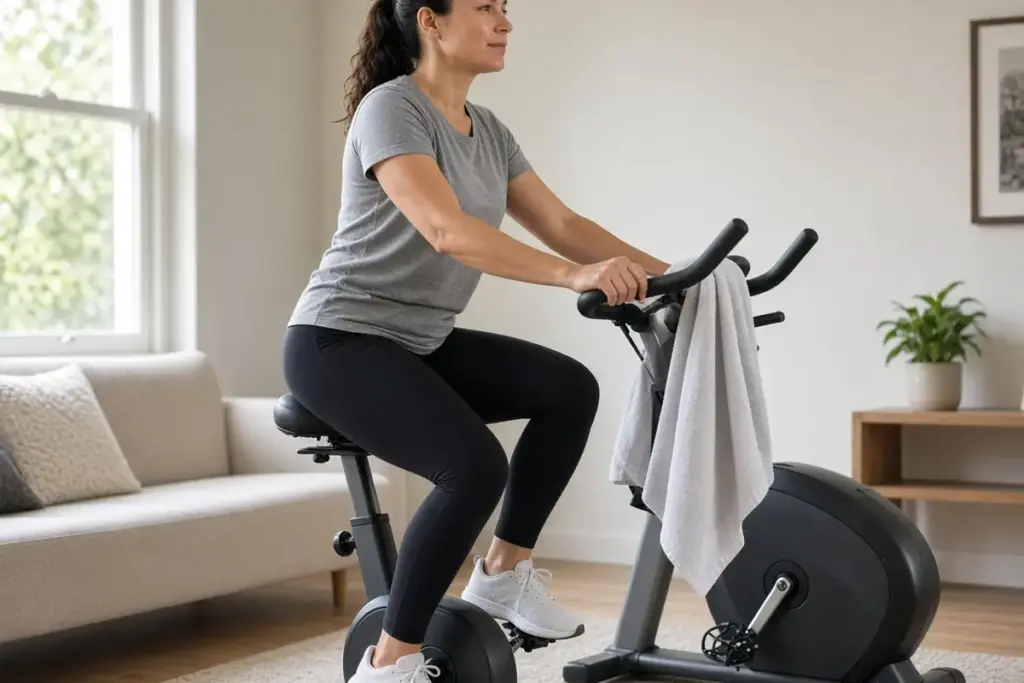
- Start with your body: joint pain points to low-impact options; running goals point to a treadmill.
- Check your space, including length for a rower and ceiling height for a treadmill.
- Train by effort. Aim for moderate or vigorous minutes [4]. The Heart Rate Zone Calculator helps set targets.
- Estimate energy use as part of your daily total with the TDEE Calculator, remembering it is an estimate.
- Mix machines if you have access to more than one, which spreads the load on different joints.
- Plan the week with the Workout Planner.
Track your cardio minutes across machines with a free Fibody membership.
Frequently asked questions
Which machine burns the most calories?
Whichever one you work hardest on for the longest. The ranges overlap a lot [2].
Is rowing a full-body workout?
It uses the legs, back and arms, but the legs do most of the work.
Is the elliptical “cheating”?
No. At vigorous effort it is listed at 9.0 METs, similar to running at 6 mph [2].
What if I have arthritis?
Exercise is strongly recommended for knee and hip OA [6]. Choose an option that does not flare your symptoms and ask your clinician.
Related on Fibody
- Tool: Heart Rate Zone Calculator, TDEE Calculator and Workout Planner.
- Method: Cycling, Running and Low-impact HIIT.
- Guide: Treadmill vs Exercise Bike vs Rowing Machine.
- Shop: Home cardio.
More in Equipment Comparisons
References
- Herrmann SD, Willis EA, Ainsworth BE, et al. 2024 Adult Compendium of Physical Activities: a third update of the energy costs of human activities. J Sport Health Sci. 2024;13(1):6-12. PMID 38242596. pubmed.ncbi.nlm.nih.gov/38242596/ (accessed 31 October 2026)
- Adult Compendium of Physical Activities. Conditioning exercise; Bicycling; Running (MET tables). pacompendium.com/conditioning-exercise/ (accessed 31 October 2026)
- Ainsworth BE, Haskell WL, Herrmann SD, et al. 2011 Compendium of Physical Activities: a second update of codes and MET values. Med Sci Sports Exerc. 2011;43(8):1575-81. PMID 21681120. pubmed.ncbi.nlm.nih.gov/21681120/ (accessed 31 October 2026)
- Bull FC, Al-Ansari SS, Biddle S, et al. World Health Organization 2020 guidelines on physical activity and sedentary behaviour. Br J Sports Med. 2020;54(24):1451-62. PMID 33239350. pubmed.ncbi.nlm.nih.gov/33239350/ (accessed 31 October 2026)
- Garber CE, et al.; American College of Sports Medicine. Position stand: Quantity and quality of exercise for developing and maintaining cardiorespiratory, musculoskeletal, and neuromotor fitness in apparently healthy adults. Med Sci Sports Exerc. 2011;43(7):1334-59. PMID 21694556. pubmed.ncbi.nlm.nih.gov/21694556/ (accessed 31 October 2026)
- Kolasinski SL, Neogi T, Hochberg MC, et al. 2019 American College of Rheumatology/Arthritis Foundation guideline for the management of osteoarthritis of the hand, hip, and knee. Arthritis Rheumatol. 2020;72(2):220-33. PMID 31908163. pubmed.ncbi.nlm.nih.gov/31908163/ (accessed 31 October 2026)
Medical disclaimer. This article summarises published research and public-health guidance for general information. It is not medical advice and does not replace a doctor, physiotherapist or other qualified professional. Stop exercising and seek medical help if you have chest pain, fainting, severe shortness of breath or sharp pain. See our Medical Disclaimer.
Last reviewed on 31 October 2026 · Next scheduled review: 31 October 2027 · Changes: First version.